
By SAL SAYGIN SIMSEK (OCTOBER 1, 2025)
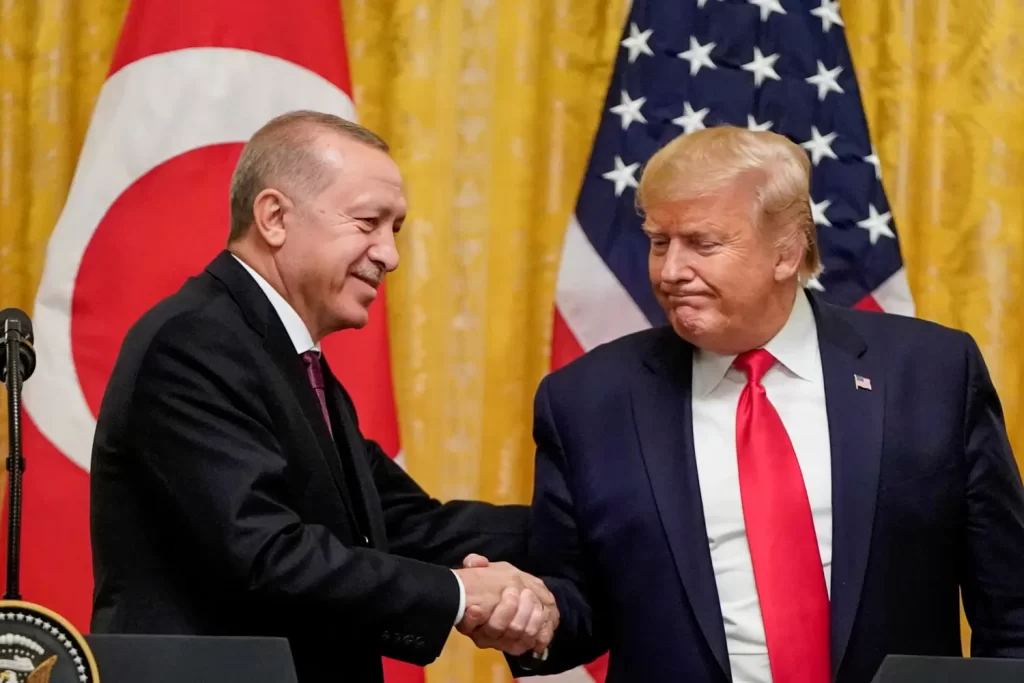
Turkiye and USA officials had very important meetings at United Nations and White House between September 23 and 29, 2025.
We can summarize the new / recent developments as below:
High-profile diplomacy & symbolism: Turkish President Erdoğan attended the U.N. General Assembly in New York, met with various international actors, and then headed to Washington for a White House visit. Ahead of the White House meeting, Turkiye announced that it would end certain retaliatory tariffs on U.S. imports (e.g. cars, rice, fruit, tobacco) that had been imposed in response to U.S. steel/aluminum tariffs in 2018. President Erdogan and Trump expressed optimism about “meaningful progress” in bilateral relations.
Defense, trade, and sanctions remain central issues: One of the major topics was the U.S. ban on advanced fighter jet sales (notably the F-35) to Turkiye, which was imposed after Turkey acquired the Russian S-400 missile system. President Trump hinted that lifting the ban is under serious consideration. President Trump asked Turkiye to cease or reduce its purchases of Russian oil; and floated the possibility of lifting U.S. sanctions to facilitate the jets deal. In the meetings, President Erdogan emphasized trade and energy as priority areas of cooperation. Turkiye’s foreign ministry highlighted that during U.N. sessions, Ankara led or supported multiple initiatives on Palestine — signaling its ongoing active diplomacy in regional issues.
Mixed signals and persistent divergence: Despite the warm tone, several analysts caution that the underlying structural divergences remain deep. There’s skepticism about how much “progress” will translate into durable shifts. Turkiye still balances its relations carefully with Russia, especially in energy and defense — which is a point of tension with U.S. expectations. No concrete commitments were announced about removing all sanctions, fully restoring U.S. defense cooperation, or resolving past disputes.
On balance, the visit and the U.N. sessions reflect a thawing or reopening of more robust dialogue between Turkiye and the U.S., after a period of relative estrangement. The tone is more cooperative, with both leaders signaling willingness to explore once-stalled issues (trade, defense, sanctions).
However, this is not a full reset. The relationship is still constrained by:
Strategic divergences (e.g. Türkiye’s ties with Russia, energy deals, regional alignments)
Domestic politics and principles (U.S. concerns about democracy, human rights, rule of law in Türkiye)
Congressional and institutional limits (e.g. U.S. Congress has its say on arms sales, sanctions)
Trust gaps built over past disputes (e.g. S-400, Syria, U.S. criticisms of Turkish domestic policies)
Both sides are signaling renewed engagement, but a durable strategic realignment would require overcoming multiple entrenched issues.
We also need to look into how various U.S. political actors — especially Congress and the defense / national security establishment — are reacting (or likely to react) to the recent warming in U.S.–Türkiye relations. The picture is mixed: there is cautious optimism in parts of the executive/defense realm, but strong reservations and constraints remain in Congress and oversight institutions.
Congress:
1. Legal constraints and oversight powers: Congress retains significant formal levers over arms sales, sanctions, and foreign aid. A major example: U.S. law currently prohibits the transfer of F-35s to Turkiye unless it no longer possesses the Russian S-400 air defense system (or related components) — a condition embedded in the FY2020 National Defense Authorization Act. Congressional committees (especially the Senate Foreign Relations Committee, the Senate Armed Services Committee, and the House Foreign Affairs Committee) can hold hearings, issue holds, refuse to approve export licenses, or push legislation that blocks or conditions arms deals. Some members of Congress have voiced skepticism about giving Turkiye advanced military systems without firm safeguards, given past actions and concerns about Turkey’s defense alignment.
2. Partisan / ideological divides: Some lawmakers, especially those focused on human rights, democracy promotion, or pro-Kurdish constituencies, remain critical of President Erdogan’s domestic policies, crackdowns on dissent, and Turkiye’s posture toward the Kurds. They are likely to push back against any moves that appear to legitimize or reward those behaviors. Other legislators, especially those more realpolitik- or security-oriented, may view restoring defense ties with a NATO ally as a pragmatic step, particularly given Turkey’s strategic location and capabilities. Some will be open to exploring compromises, e.g. offering F-16 upgrades rather than jumping directly to F-35s.
3. Historical precedents and cautious momentum: As recently as early 2024, the Senate defeated an effort to block a large F-16 sale to Turkiye (79 to 13), showing that when geopolitics align, Congress can allow significant arms deals to proceed. However, the momentum is fragile: opposition forces could mount renewed efforts if concerns (e.g. about Russia ties, human rights, or the S-400 issue) flare up again. Some analysts warn that Congress may act as a brake on overly ambitious rapprochement, especially if the executive branch tries to relax restrictions too fast.
4. Decline of Turkiye caucus influence: In past decades, there was a sizable “Turkiye Caucus” in Congress, a bipartisan grouping of legislators supportive of strong U.S.–Turkiye engagement. Over time, its membership and influence have waned, partly in response to deteriorating perceptions of Erdogan’s Turkiye. That reduction in congressional political constituency for Turkey makes it harder for pro-Turkey voices to mobilize support for controversial deals.
U.S. Defense / National Security Establishment:
1. Pragmatic openness, but with redlines: Many in the Pentagon, the arms acquisition community, and the defense diplomacy establishment see value in restoring interoperability with Turkiye, enhancing NATO cohesion, and modernizing Turkiye’s aging fleet (F-16 upgrades, eventually perhaps involvement in F-35 or successor systems). Some Defense and National Security actors appear receptive to working to “remove obstacles” in defense-industry cooperation between Turkiye and the U.S., as long as safeguards (technology transfer, NATO compatibility, oversight) are preserved. Analysts note that Turkiye has been evolving more toward a defense-exporter role itself (e.g. drones, unmanned systems), which offers potential synergies if trust can be rebuilt.
2. Skepticism on S-400 and security compatibility: A major concern remains Turkiye’s acquisition and continued possession of the S-400 system. Critics in the defense community argue that presence of S-400s in a NATO ally’s air-defense architecture creates risks of intelligence intrusion, interoperability dysfunction, or compromise of U.S. systems (especially stealth fighters). The U.S. has reaffirmed in internal communications that it has not changed its core position on the S-400 — i.e., Turkiye must divest or neutralize it to regain access to certain advanced systems. Some in the defense establishment are wary of giving Turkiye access to the F-35 or similar advanced platforms too soon, before resolving the S-400 issue and implementing strong operational safeguards.
3. Institutional inertia, risk aversion, and legacy mistrust: Military-to-military trust was eroded over years (e.g. purges in Turkiye’s officer corps after the 2016 coup, divergence in regional operations, Syria/Kurdish policies), so rebuilding relationships will take time and consistent confidence-building. Defense technical bureaucracy is naturally cautious about technology-sharing, export controls, transfer of sensitive systems, and ensuring U.S. systems are not undermined. Any proposal to re-integrate Turkiye into advanced systems will be subjected to rigorous joint reviews, risk assessments, and oversight by defense, intelligence, and security agencies. As long as regional tensions (e.g. over Eastern Mediterranean, Syria, or relations with Russia) remain volatile, defense planners may prefer a gradual, incremental rapprochement rather than sweeping reversals of prior restrictions.
Putting it together, here’s how these reactions shape the possible trajectory:
Executive branch / diplomacy will probably continue pushing for cautious rapprochement, leveraging the symbolic momentum of recent meetings. They may propose pilot or limited defense deals (e.g. F-16 modernization) as confidence-building steps.
Defense establishment is likely to support incremental steps, but will resist any reversal of red lines until Turkiye’s security posture (especially regarding the S-400) is convincingly aligned with NATO/U.S. standards.
Congress remains the most unpredictable check: even if the administration wants to move fast, legislative resistance or public scrutiny could slow down or scale back deals.
As a conclusion, the warming in diplomacy is welcomed by many defense/security actors as an opportunity, but constrained by institutional caution and congressional oversight. If a breakthrough is to happen (e.g. full restoration of advanced arms cooperation), it will likely come slowly, with many conditional safeguards and perhaps even new legislation to codify terms.