
By Sal Saygin Simsek (March 18, 2026)
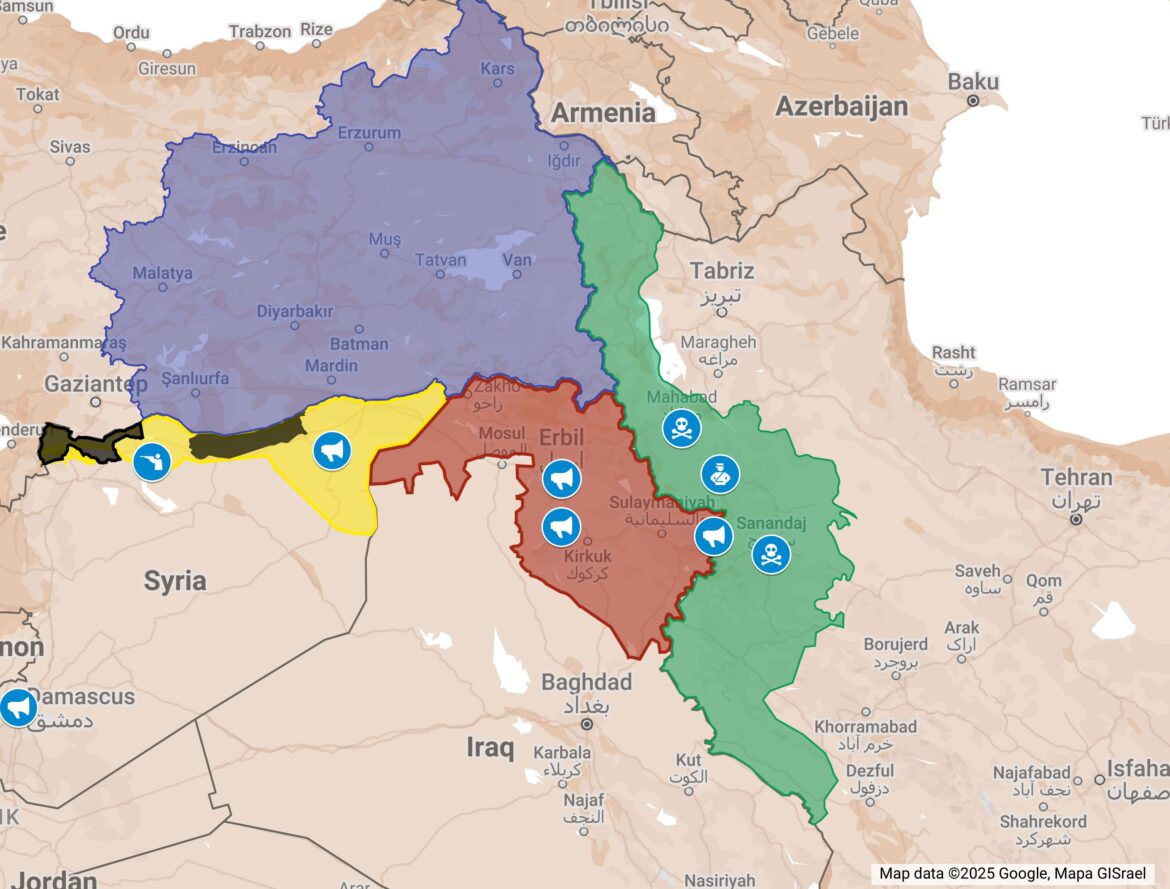
Turks and Kurds cooperate depending on security, politics, history, and trust, all of which are complicated. Iran related tensions are rising in the region. Iranian missiles have recently entered Turkish airspace three separate times and been intercepted by NATO systems. Iran has also conducted missile and drone attacks in Kurdish regions of Iraq. Kurdish areas inside Iran are facing airstrikes and heavy military pressure.
There are shared security threats. Iran’s actions (missiles, militias, cross-border strikes) can affect Turkiye’s borders and NATO bases and Kurdish regions in Iraq and Iran. In that sense, there is a common external pressure. A wider war destabilizes trade routes, energy supply, and border regions where both Turks and Kurds live. There is risk of being caught in a larger war. Kurdish groups are already “caught in the middle” of bigger powers, and Turkiye is trying to avoid being pulled deeper into the conflict. Therefore, cooperation could theoretically reduce chaos along borders.
This will be difficult to accomplish due to Long-standing conflict between Turkiye and Kurdish groups. There are decades of conflict with groups like the PKK and thousands of deaths and deep mistrust. Turkiye prioritize territorial integrity and security and many Kurdish groups: seek autonomy or independence. However, Kurds who live across Turkiye, Iran, Iraq, and Syria are not unified. Different factions have different alliances and agendas, thus, there is no single Kurdish position to “join forces.”
Turks and some Kurdish groups could cooperate tactically against shared threats like instability or cross-border attacks. This can start as temporary, indirect alignment (e.g., both avoiding escalation), local coordination in specific areas (border security, intelligence) that can turn into a full political or military alliance in the future.
A real Turkish–Kurdish alignment against Iran-linked attacks would require something much narrower and more practical than a grand alliance. And if even limited coordination happened, it would matter for NATO, energy routes, and the regional balance of power because Turkiye has already had multiple Iranian missiles intercepted in its airspace by NATO systems, while Iraqi Kurds has also been hit amid the wider conflict.
First, the most important condition would be a ceasefire or de-escalation in the Turkiye–PKK conflict. Turkiye, the U.S., and the EU classify the PKK as a terrorist organization, and that conflict has been the central obstacle to any durable Turkish–Kurdish security cooperation. Reuters also reports that Turkiye opened a peace process in 2025 and that Abdullah Öcalan called on the PKK to lay down arms, though the process has since stalled.
Second, any alignment would likely need to be with specific Kurdish actors, not “the Kurds” as a whole. Kurdish politics are fragmented across Turkiye, Iraq, Syria, and Iran, and Iraqi Kurdish authorities, Turkish Kurdish political parties, PKK-linked structures, and Iranian Kurdish groups do not all share the same goals or command structure. That means cooperation, if it happened, would probably be selective and local rather than broad and ethnic-wide.
Third, Turkiye would need confidence that cooperation would not strengthen armed anti-Turkish networks along its borders. That is the core Turkish fear: that any crisis involving Iran could also create space for PKK-linked or other armed Kurdish groups to gain legitimacy, weapons, or territory.
Fourth, the most realistic model would be practical coordination rather than political reconciliation. In plain terms, that could look like intelligence-sharing on missile launches, deconfliction around border zones, joint protection of civilian areas, and pressure on Iran-backed militias that threaten both Turkiye and Iraqi Kurds. That is much easier to imagine than Turkiye endorsing Kurdish autonomy projects or Kurdish armed groups integrating with Turkish security policy. The current pattern of missile defense deployments and strikes on Iraqi Kurds makes this kind of narrow security logic more plausible than a full alliance.
For NATO, even limited Turkish–Kurdish coordination would matter because Turkiye is the alliance’s southeastern anchor, and NATO is already reinforcing air defenses in southern Turkiye after repeated missile interceptions. There is an additional U.S. Patriot system is being deployed to Adana near Incirlik, alongside earlier reinforcement in Malatya. That means Iran-related spillover is no longer theoretical for NATO; it is already shaping alliance deployments.
For energy, the issue is huge. Iraq is trying to safeguard tanker traffic through Hormuz while also looking to revive the Kirkuk–Ceyhan pipeline to Turkiye, a route that could move crude to Ceyhan without relying on Gulf transit. Reuters says that route could initially handle around 250,000 barrels per day and later potentially 450,000 bpd including Kurdish fields. So if Turkiye and Iraqi Kurdish actors were even minimally aligned on security, that could improve confidence around one of the few major alternatives to Hormuz exposure.
For the regional balance of power, a Turkish–Kurdish understanding would complicate Iran’s strategy. Reuters reports that Iran’s allied militias in Iraq and elsewhere remain active despite setbacks, and Iraqi Kurds has already seen attacks on NATO-linked facilities. If Ankara and some Kurdish authorities coordinated more closely, it could reduce the room Iran-backed groups have to pressure both sides separately.
However, there is an opposite risk too: such cooperation could escalate competition. Iran could view deeper Turkiye–Kurdish coordination as hostile encirclement, while Turkish nationalists could fear that crisis-era Kurdish cooperation would later be used to press autonomy claims. In other words, the same move that might strengthen short-term security could also intensify the long-term political struggle. That is an inference from the combination of current missile incidents, NATO reinforcement, the stalled peace process, and the unresolved status of Kurdish actors across the region.
There can be a limited tactical coordination against missile threats, militia attacks, and energy-route disruption. That would still be important because it could help NATO stabilize Turkiye’s southern flank, help protect Iraqi Kurdish territory, and make Turkiye’s energy corridor role more valuable. A true political-military alliance will be possible after the Turkiye–PKK peace track becomes much more credible than it is now if United States and its allies can take active role in these peace talks.